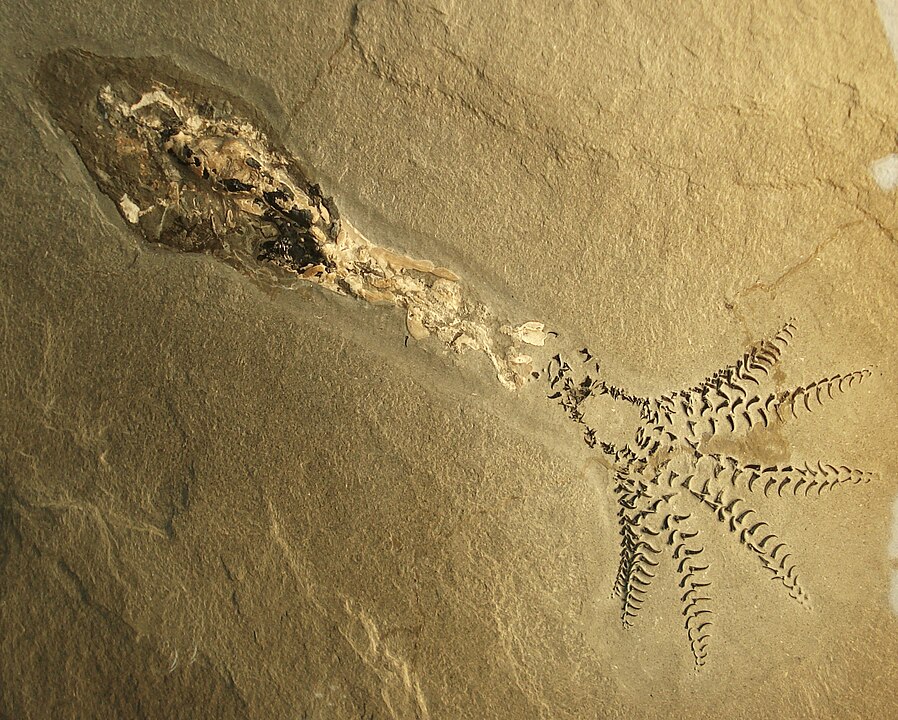
The Belemnites are an extinct group of marine cephalopods, very similar to modern cuttlefish and closely related to modern squid. They lived from the Late Triassic period, about 234 million years ago, to the end of the Cretaceous period, 66 million years ago.
It is assumed that belemnites fed on crustaceans and mollusks, and they themselves were an important source of food for sharks and marine reptiles of the Mesozoic era (mosasaurs, plesiosaurs, ichthyosaurs, etc.).
Like cuttlefish and squid, belemnites had an ink sac. In contrast to octopuses, they had ten arms of approximately equal length and no tentacles. Their bodies contained an internal skeleton.
The most commonly found belemnite fossil is its conical shell. These fossils have been known since antiquity, when they were believed to be gemstones or thunderbolts that had fallen from the sky, as they were often exposed after storms. In southern England, they were believed to cure rheumatism and various eye ailments, although such treatments actually aggravated the eye conditions. In western Scotland, they were believed to cure respiratory diseases in horses.
Gradually, competition from octopuses and cuttlefish led to a decline in belemnite populations, which eventually disappeared with the dinosaurs at the end of the Cretaceous period, 66 million years ago.
The belemnite genus Belemnitella was designated the state fossil of Delaware in the United States of America.