Although birds are known to belong within the dinosaur evolutionary tree, reconstructing the development of wings has been difficult when researchers have had only bones to study.

By illuminating almost invisible soft-tissue traces from a bird-like animal, palaeontologists have produced a more detailed picture of how some dinosaurs may have become capable of flight.
Dinosaur soft tissues generally decomposed long before fossilisation, leaving mainly teeth and bones, and occasionally faint traces of the animal’s external appearance.
Recent technologies have revealed previously hidden fossil details, including patterns and shades of pigmentation in dinosaur skin and feathers.
An international team of palaeontologists reconstructed aspects of the skin by applying laser-stimulated fluorescence to eight specimens of Anchiornis huxleyi.
Anchiornis huxleyi, a crow-sized feathered animal, lived approximately 160 million years ago during the Late Jurassic in what is now China. It was related to Microraptor and Archaeopteryx.
A high-powered laser beam of a specific wavelength revealed colours and structures that were invisible under ordinary light.
The technique confirmed that Anchiornis was distinctly bird-like, with predominantly grey and black plumage, long feathers on its slender arms and legs, and a reddish-brown crest on its head. It also had a skin membrane connecting parts of the forelimb.
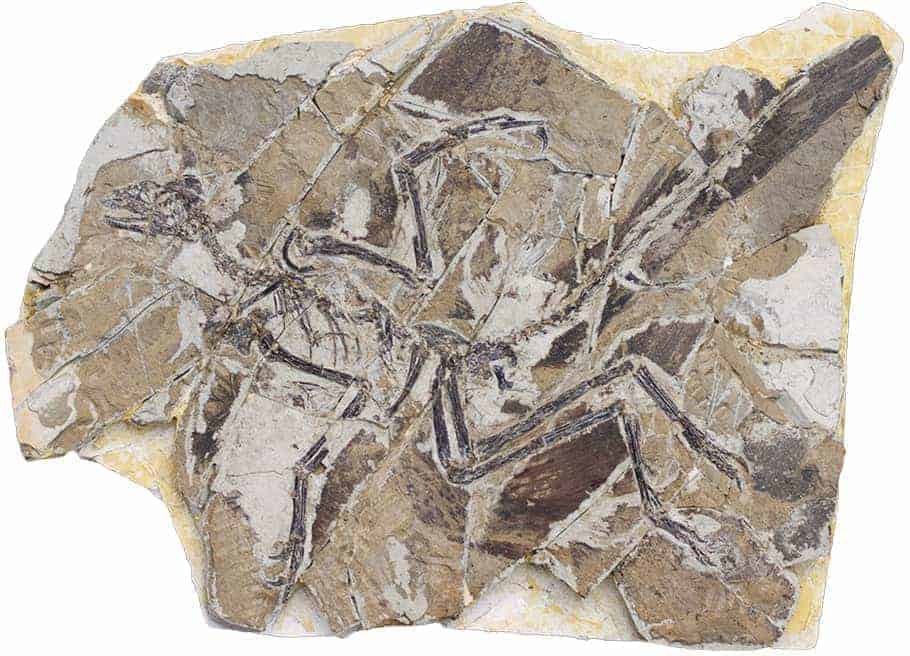
This skin fold may help explain the anatomical features involved in the transition from non-avian dinosaurs to birds.
Although it remains unclear whether Anchiornis could fly, its anatomy suggests that it was close to acquiring the ability to leave the ground.
“It is exciting to have discovered a true wing in a prehistoric bird-like animal,” said researcher Michael Pittman.
