The Burgess Shale Formation in British Columbia, Canada, preserves fossils of many remarkable organisms that document the evolution of life on Earth. One is Habelia optata – a 508-million-year-old ancestor of scorpions and other chelicerates. It was an effective predator with body armour and five pairs of jaws.
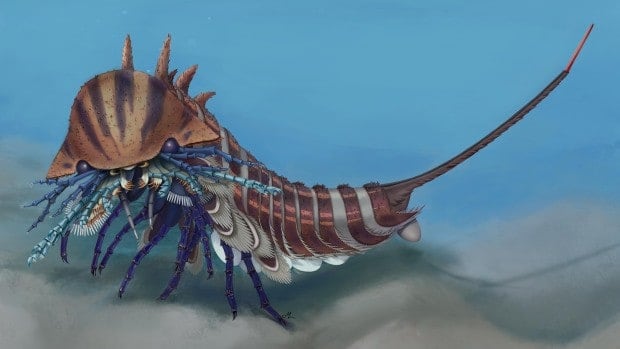
Even today, the oceans contain many poorly understood organisms. Aquatic life during the Cambrian explosion, 508 million years ago, was similarly diverse, yet far less is known about it. During the Cambrian Period, aquatic organisms diversified and gave rise to early predators, including Habelia optata.
Habelia optata was first described more than 100 years ago from fossils found in the renowned Burgess Shale Formation of British Columbia, Canada. Its anatomy was unusual: it had five pairs of jaws, body armour and a complex head capable of breaking the hard exoskeletons of small trilobites. Despite measuring only about 2 cm in length, Habelia was an effective predator, equipped with the structures needed to survive in Cambrian waters.
A more detailed study of this unusual organism, which lived more than 500 million years ago, revealed important aspects of its evolutionary relationships. Habelia optata was clearly an arthropod, with a segmented body, an exoskeleton and jointed limbs. Detailed anatomical analysis places it among the chelicerates, close to the ancestry of horseshoe crabs, scorpions, other arachnids and sea spiders. This finding helps address questions about the evolution of chelicerates and related groups.

“We can now explain, for example, why horseshoe crabs have a pair of reduced appendages at the base of the head. These are remnants of fully developed limbs, as chelicerates appear to have had heads with at least seven pairs of appendages,” said Cédric Aria, a researcher at the Nanjing Institute of Geology and Palaeontology and lead author of the study published in BMC Evolutionary Biology.
To investigate the organism in detail, researchers examined 41 specimens of Habelia optata, carefully measuring each fossil to produce accurate three-dimensional reconstructions of this Cambrian predator. They found that Habelia used a head appendage to crush objects, whereas modern arthropods use the corresponding appendage for locomotion. Some specialised jaws may have served a sensory function comparable to the antennae of modern insects.
Aria noted that, despite its age, the organism had exceptionally sophisticated anatomy: “It is much more complex than many living chelicerates.” Equipped with powerful predatory structures, Habelia optata could break the hard exoskeletons of small trilobites. “This complex arrangement of appendages and jaws made Habelia an exceptionally effective predator despite its small size. It was certainly highly mobile and very efficient at crushing prey,” Aria said.
The Burgess Shale Formation continues to yield fossils of numerous ancient organisms, such as Habelia optata – which help us understand the evolution of life on Earth. Habelia is one example among hundreds of organisms whose specialised adaptations contributed to the emergence of the groups known today.
Source: Smithsonian, Phys.org
