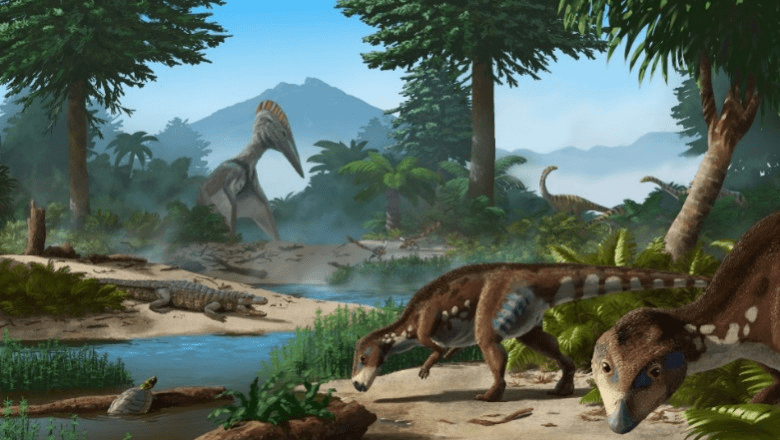
Transylvanosaurus platycephalus or the “flat-headed lizard from Transylvania”, is the most recently discovered dwarf dinosaur from Romania’s Hațeg Basin, representing a new genus and species. The research was formally published in 2022 in the Journal of Vertebrate Paleontology. The discovery of Transylvanosaurus platycephalus suggests that the biogeographical history of the family Rhabdodontidae was much more complex than previously thought.
The first discoveries of fossilised dinosaur bones in Hațeg
In 1895, Ilona, the sister of Transylvanian baron Franz Nopcsa, discovered on the family estate what would become the first dinosaur fossils from the Hațeg region. Inspired by this discovery, the young Nopcsa went to study at the University of Vienna, where he visited the renowned palaeontologist Eduard Suess. He showed Suess the bones in an attempt to understand their significance. Impressed, Suess encouraged him to study the collected fossils himself. At just 22 years of age, during his first year at university, Nopcsa published a paper describing a new duck-billed dinosaur (hadrosaur), which he named Telmatosaurus transylvanicus. Although the specimen was an adult, this hadrosaur was relatively small, with a body length of no more than 5 metres. “Nopcsa was asking questions that no one else had considered,” says Professor David Weishampel, a palaeontologist at the Center for Functional Anatomy and Evolution at Johns Hopkins University. (1)
Hațeg palaeodiversity in the Late Cretaceous
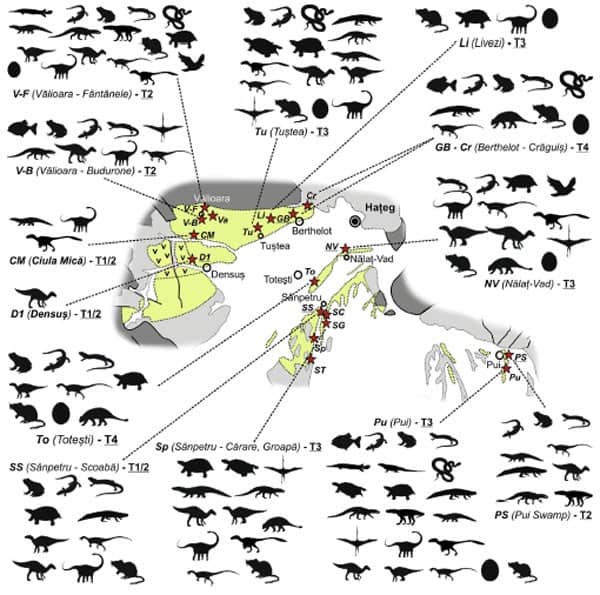
Nopcsa continued a productive period of research, discovering a total of five dinosaur species, a crocodilian, a turtle and a pterosaur. An aquatic bird described by a British researcher who was a friend of Nopcsa was later added to this assemblage. This diversity, comprising nine contemporaneous species inhabiting the same geographical area, includes dinosaurs and other animal groups. It is remarkable among European faunas from the end of the Mesozoic Era and makes this region renowned for its palaeodiversity. Following a hiatus of half a century, intensive research resumed in the Hațeg region. Approximately 60 species are now known, representing all major vertebrate groups: fish, amphibians, reptiles (snakes, lizards, crocodilians and dinosaurs), birds and mammals.
The dwarf dinosaurs of Hațeg
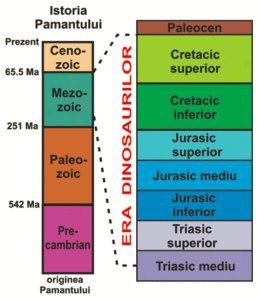
The dinosaurs of Hațeg have distinctive characteristics. They are known as the “dwarf dinosaurs of Transylvania” because they were smaller than related species from other parts of Europe. What explains this difference? Franz Nopcsa was the first palaeontologist to describe the phenomenon, which he termed “insular dwarfism”. “island theory”, as it is also called, remains widely accepted. During the Cretaceous, approximately 70–67 million years ago, shortly before the extinction of the non-avian dinosaurs, the Hațeg region was a tropical island in an archipelago within the Tethys Ocean, the precursor of the Mediterranean Sea. Nopcsa called it “Hațeg Island”. Dinosaurs that inhabited the island over prolonged periods evolved relatively small body sizes in response to the limited food resources and space available in an island environment.

Romania’s most recently discovered dwarf dinosaur
The most recent discovery of a dwarf dinosaur representing a new genus and species was made by an international team of palaeontologists led by Felix Augustin of the University of Tübingen. The team included Associate Professor Zoltán Csiki-Sava of the Faculty of Geology and Geophysics at the University of Bucharest, Dylan Bastiaans of the University of Zürich and independent researcher Mihai Dumbravă from Dorset. Although the fossils were found in 2007, the research was formally published in 2022 in the scientific journal Journal of Vertebrate Paleontology. The fossils formed the type material, the specimens on which the definition of a new species is based, of a new rhabdodontid dinosaur named “Transylvanosaurus platycephalus”, or the “flat-headed lizard from Transylvania”.
Taxonomy
The species name highlights its origin, while the genus name describes the exceptionally flattened shape of the skull compared with other rhabdodontids. Etymologically, “Transylvanosaurus” means “lizard from beyond the forest”, from the Latin Trans (“beyond”), silva (“forest”) and the Greek sauros (“lizard”), while “platycephalus” means “flat-headed”, from the Greek platys (“flat”) and the Greek cephalos (“head”).
The dinosaur’s fossilised bones Transylvanosaurus platycephalus
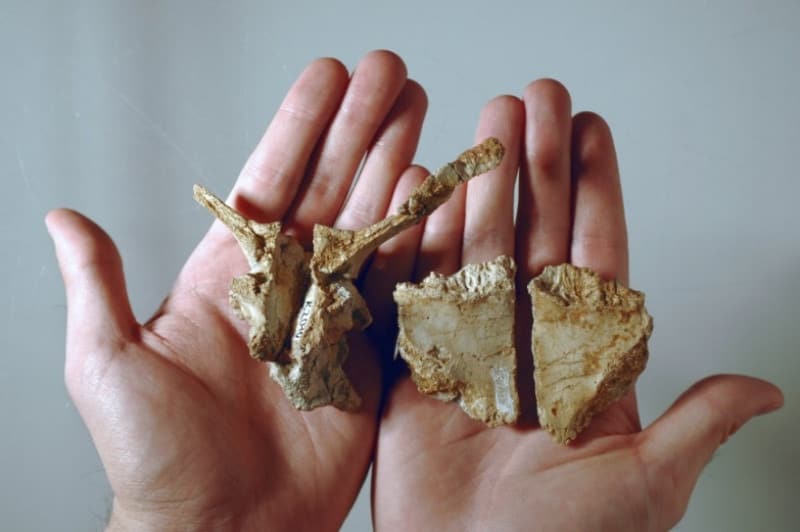
The fossils are well preserved and comprise the articulated bones of the skull base and both frontal bones. They were recovered from the eastern part of the Hațeg intermontane basin, along the Bărbat River valley near Pui. The original specimen is currently housed in the Palaeontology Laboratory of the Faculty of Geology and Geophysics at the University of Bucharest. Photogrammetric techniques, which convert two-dimensional information into three-dimensional models, were used to produce several 3D replicas held in the Palaeontological Collection of the University of Tübingen.
Significance of the discovery
Transylvanosaurus platycephalus was a bipedal herbivorous dinosaur approximately 2 metres in length. The specimen was most likely a subadult, as most cranial sutures had not yet closed. Comparative morphological and phylogenetic analyses consistently supported its assignment to the family Rhabdodontidae. The discovered fossils form one of the most complete Late Cretaceous rhabdodontid skulls from eastern Europe.
Although Transylvanosaurus appears to have been similar in size to related Romanian species in the genus Zalmoxes, the new dinosaur differs considerably in skull morphology, suggesting differences in feeding. Its cranial bones also appear more similar to those of species from southern France. How can this relationship be explained? Researchers suggest that sea-level fluctuations and tectonic processes created temporary land bridges between islands, allowing dinosaurs to disperse to other territories.
In conclusion, deposits of the Hațeg Basin contain some of Europe’s richest and most diverse Late Cretaceous fossil vertebrate assemblages. The discovery of Transylvanosaurus platycephalus suggests that the biogeographical history of the family Rhabdodontidae was much more complex than previously thought.
Hațeg Country UNESCO Global Geopark
Here you can learn more about Transylvania’s dwarf dinosaurs. For a distinctive cultural experience, we invite you to explore the Hațeg Country UNESCO Global Geopark.
References
- Veselka, Vanessa, History Forgot This Rogue Aristocrat Who Discovered Dinosaurs and Died Penniless, Smithsonian Magazine, 07.2016
- Augustin, F., Bastiaans, D., Dumbravă, M. D., Csiki-Sava, Z., A new ornithopod dinosaur, Transylvanosaurus platycephalus gen. et sp. nov. (Dinosauria: Ornithischia), from the Late Cretaceous of the Haţeg Basin, Romania, Journal of Vertebrate Paleontology, 27.10.2022, e2133610
- https://zoobank.org/References/57B462E5-E08E-42DC-B256-4E978DFBFCC7
- https://www.hateggeoparc.ro

[…] more information about island gigantism or dwarfism, we invite you to read this article about Hațeg Island in the Cretaceous period on […]