What was the largest insect ever to inhabit Earth? It was Meganeuropsis permiana, a giant dragonfly-like insect that lived before the dinosaurs.
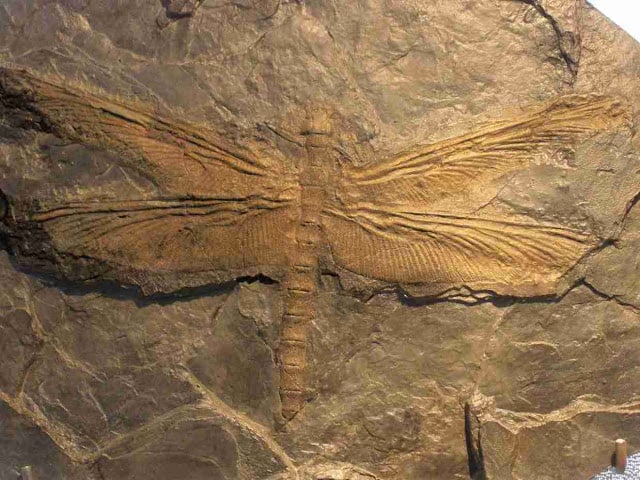
Earth was very different 300 million years ago. During the Carboniferous and Permian periods, insects could attain very large sizes. One contributing factor was the high atmospheric oxygen concentration, which directly influences the size an insect can reach.
Meganeuropsis permiana lived approximately 275 million years ago, during the Permian, and is the largest insect identified to date. Although it resembled a modern dragonfly, this giant insect was only a distant relative, as true dragonflies had not yet appeared.

The giant insect’s body measured almost 430 mm from head to tail. Each wing reached up to 330 mm in length, with a wingspan of up to 710 mm. Its mass is estimated at more than 450 g, comparable to that of a crow.
Meganeuropsis permiana was a predatory insect whose hunting behaviour is thought to have resembled that of modern dragonflies. Its size may have allowed it to prey on a wider range of animals. Its large eyes helped it track prey, while spines on its limbs assisted in capture.
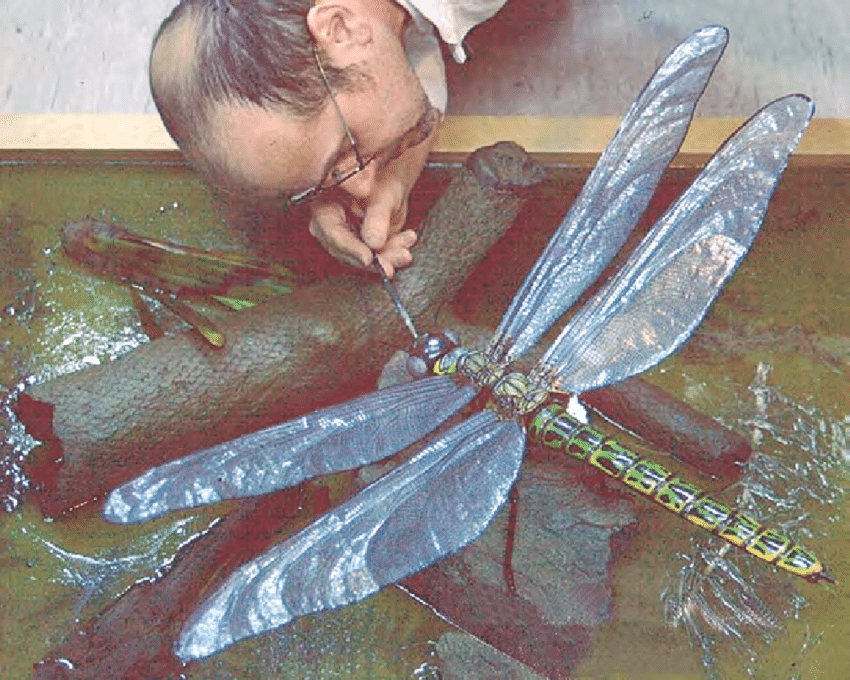
The wings had a network of reinforced veins, reflected in the name “Meganeura”, meaning “large-veined”. These veins provided considerable strength and differ from the delicate wings of modern dragonflies.
Meganeuropsis permiana belonged to a group of primitive insects, precursors of modern dragonflies, known as griffinflies or Meganisoptera. These insects lived from the late Carboniferous, approximately 317 million years ago, to the end of the Permian, approximately 247 million years ago. The first fossils of these enormous insects were discovered in France in 1880, followed by discoveries in Bolsover, Derbyshire, in 1979.
It is thought that these insects could not survive under present atmospheric conditions, which would no longer support their enormous bodies. A decline in atmospheric oxygen concentration is therefore considered a possible explanation for their extinction.
Meganeuropsis permiana is the largest insect identified to date, but it is only one example of the remarkable organisms that inhabited Earth long before humans. Many species remain to be discovered, and their fossils will help us better understand the history of our planet.
Sources: EarthArchives, GeologyIn
