The head of what appears to be the smallest dinosaur identified to date was found preserved in amber and dates to approximately 99 million years ago.

Amber has yielded numerous palaeontological discoveries, including prehistoric insects and dinosaur feathers preserved in hardened resin, providing a window into the past. It also appears to have preserved the smallest dinosaur identified to date.

The discovery consists of the head of what appears to be a bird-like dinosaur, resembling a hummingbird, preserved in a piece of amber from Myanmar. The fossil dates to approximately 99 million years ago and displays characteristics that surprised researchers.
The dinosaur, named Oculudentavis khaungraae – loosely translated as “eye-tooth bird”, was so small that it probably weighed no more than 2 grams. The skull preserved in amber measures just 1.5 cm, and its proportions suggest that the animal was approximately the size of a hummingbird.

The fossil discovered in Myanmar has large eye sockets on the sides of the skull, resembling those of modern lizards. Narrow openings associated with the eyes limited the amount of light entering them. This characteristic suggests that the animal was diurnal.
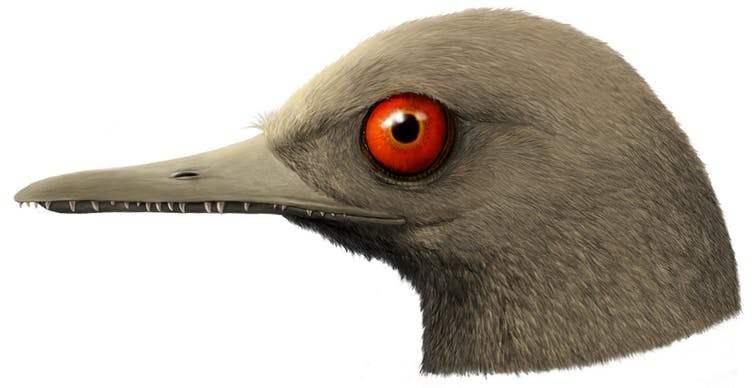
Both sides of the mouth contain numerous sharp teeth, suggesting that Oculudentavis khaungraae was a predator. It probably fed on insects or other small invertebrates. Researchers consider its small size an example of insular dwarfism, as it most likely inhabited islands located in what is now Myanmar.
As only the skull has been found, researchers cannot determine precisely how Oculudentavis khaungraae was related to other bird-like dinosaurs, nor can they establish whether it could fly. They nevertheless suspect that it belonged to a relatively primitive group of birds representing evolutionary links between birds and dinosaurs, possibly resembling Archaeopteryx and Jeholornis, which lived approximately 150–120 million years ago.
The small dinosaur may have had feathered wings, but further fossils are needed to determine how it flew. Despite its hummingbird-like size, Oculudentavis khaungraae did not feed on nectar. Its teeth and large eyes suggest predatory behaviour and form a combination of features not previously observed in another dinosaur or a modern animal.
This unusual discovery raises questions about what other prehistoric animals remain to be found in the amber deposits of Myanmar and elsewhere.
Sources: Scientific American, Live Science, National Geographic, BBC News

CONGRATULATIONS, very interesting to want to watch movies too!