British researchers have announced the discovery of fossil microorganisms potentially dating to 3.77–4.29 billion years ago. If confirmed, they would represent the oldest evidence of life on Earth, Agerpres reports.
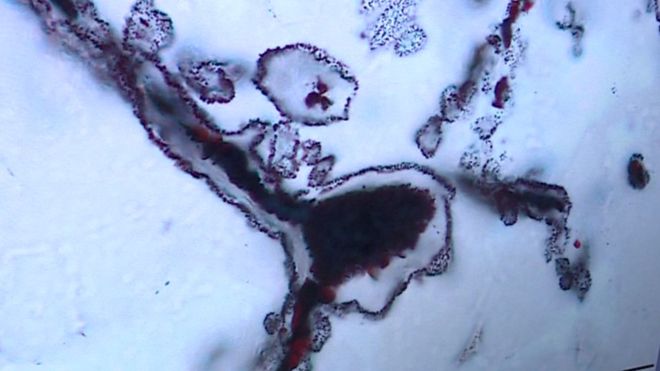
The researchers discovered the microfossils in quartz-bearing rocks at Nuvvuagittuq in north-eastern Québec, Canada.
“Laser imaging of the collected samples allowed us to identify what are the oldest microfossils in the world,” said Matthew Dodd of University College London (UCL) in a video posted on the website of Nature.
The microfossils resemble bacteria living around hydrothermal vents on the seabed today and may represent the oldest known evidence of life on Earth.
According to the researchers, the fossils from the Hudson Bay coast in northern Québec, near the Nastapoka Islands, support the hypothesis that hydrothermal vents provided an environment for the origin of life relatively soon after Earth formed.
They also suggest that neighbouring Mars had oceans at that time, now long vanished, which could have provided similar conditions conducive to the emergence of life.
Small filaments and tubes composed of iron oxide, interpreted as microbial structures, were found embedded in quartz-bearing rocks. Their age was estimated at 3.77–4.28 billion years.
The researchers expressed confidence that the Canadian structures were biological in origin, stating that no non-biological explanation appeared plausible.
Primordial microbes such as those described in the study began the evolutionary history that led to complex life and eventually to humans approximately 200,000 years ago, Reuters reports.
“Understanding how and when life began on Earth helps address long-standing questions: Where do we come from? Is there life elsewhere in the universe?” Dodd said.
The researchers noted that the ancient microbial structures closely resembled those of living bacteria associated with iron-rich hydrothermal vents. They suggest that, like their modern counterparts, these microbes metabolised iron.
UCL researcher Dominic Papineau emphasised the discovery’s relevance to the origin and evolution of life. It suggests that microbial life diversified into specialised forms very early in Earth’s history and that some microbial structures have remained broadly similar since those early times.
Earth formed approximately 4.5 billion years ago, and oceans appeared around 4.4 billion years ago. If the fossils are indeed 4.28 billion years old, they would suggest an almost immediate emergence of life after ocean formation, Dodd noted.
These fossils appear older than previously identified evidence of life. For example, the preceding year, researchers described 3.7-billion-year-old fossil microbial mats, known as stromatolites, from Greenland.
