


Description
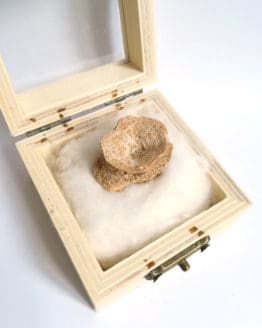
Meteorites are rocks from space that enter a planet's atmosphere and reach its surface. They are the result of incomplete combustion in the atmosphere of meteoroids – pieces of various sizes of iron and rock, resulting mainly from the collision of asteroids. Chondrite is the most common type of meteorite. It is a stony meteorite whose internal structure contains small spherical grains called chondrules. It consists of olivine (40%), pyroxenite (30%), plagioclase (10%), an Fe–Ni alloy (10–20%), and troilite (5–15%). This composition suggests that chondrite fragments come from the mantles of forming planets, and carbon dating indicates that they are over 4.6 billion years old, the estimated age of our solar system. H chondrite meteorites are the most common chondrite meteorites, and the letter H refers to their high iron content compared with other types of chondrite (“High iron abundance”). Most chondrite meteorites are found in North Africa, in the Sahara Desert, and are known as N.W.A. (Northwest Africa).









Reviews
There are no reviews yet.