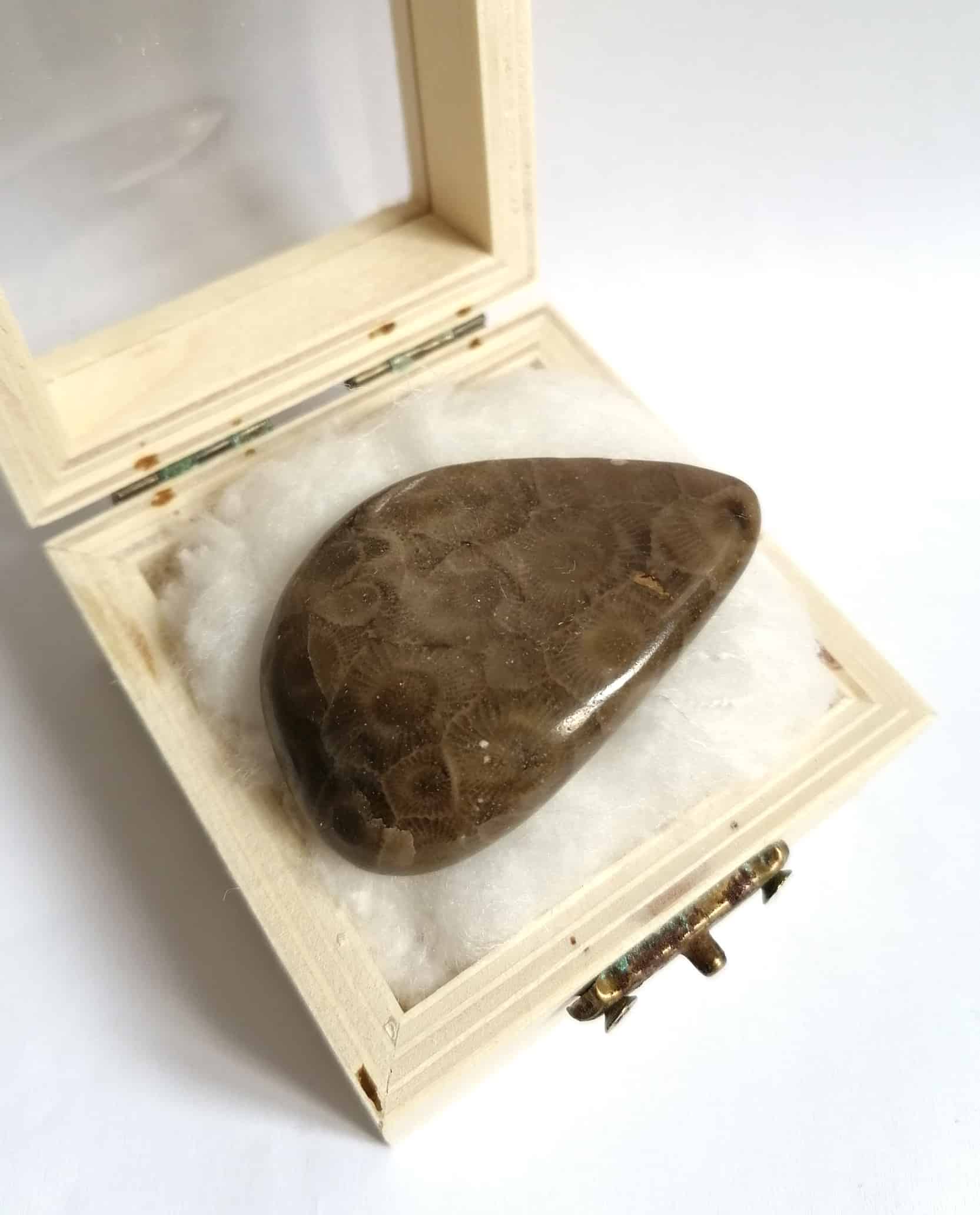
Authentic agatized fossilized cone · 4.6 cm length
40 million years old · Eocene · Morocco
RON 169,99
Authentic agatized fossilized cone specimen from Morocco, approximately 40 million years old. It comes in a wooden box with a transparent lid, suitable for display, and is accompanied by a Certificate of authenticity signed by a professional geologist who examined the specimen. The fossilized cone shown here probably belongs to a cycadophyte, although its genus and species have not been confirmed. Silicification, often referred to as agatization, has preserved details of its structure. A fascinating plant fossil and an excellent addition to a paleontology enthusiast’s collection!
Due to its age, the specimen may have imperfections and repaired areas (glued sections) which are perfectly normal and often unavoidable, but it is, overall, in good condition. We invite you to carefully study the product photos to identify the natural imperfections and possible repairs of the specimen.
Click here for more general information about fossils
Specimen: authentic agatized fossilized cone (probably from a cycadophyte)
Age: approximately 40 million years old, Eocene epoch
Dimensions: approximately 4.6 cm length (please see the photo showing the specimen next to a ruler or held in a hand to get an idea of its size)
Country of origin: Dakhla, Morocco
The product consists of a single authentic agatized fossilized cone in a wooden box with a transparent glass lid, the one shown in the photos above, and comes with a Certificate of authenticity signed by a professional geologist who examined the specimen.
Out of stock
Description
Cycads are an ancient group of seed plants, with a fossil history of over 250 million years. They were widespread in the Mesozoic Era, at the time of the dinosaurs, and representatives of the group are still alive today. With their sturdy trunk and large leaves arranged in a crown, many cycads resemble palms, but they belong to a different group of plants.
Cycads are gymnosperms: their seeds are not enclosed in fruits and they do not produce true flowers. In most species, the reproductive structures are cone-shaped, and pollen and seeds develop on separate male and female plants.





Reviews
There are no reviews yet.