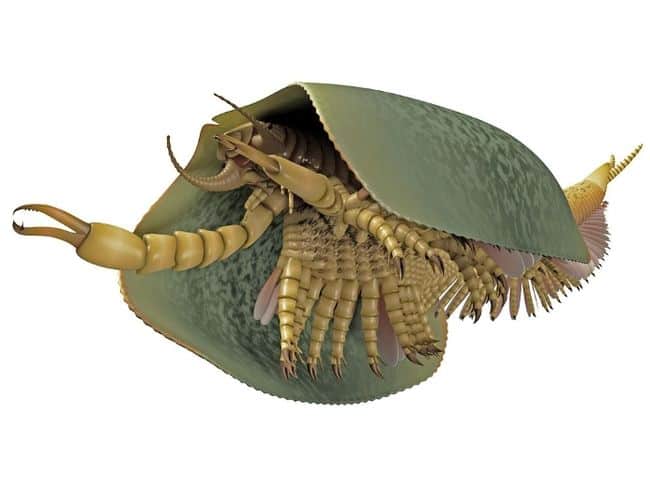
An important palaeontological discovery was made in Canada in 2012. Researchers identified one of the earliest predators discovered to date in Kootenay National Park, British Columbia. The fossil was dated to 508 million years ago.Tokummia katalepsis resembled an unusual lobster. It measured 10 cm, had 50 legs and two pincers, and bore a tent-like carapace over its body. The legs were used for swimming and moving along the seabed, while the powerful pincers captured worms and other prey. A bivalved carapace protected the body, and two small eyes lay at the ends of its antennae. Its most notable feature was a serrated mandible: it is the oldest known arthropod with this structure.

Although many familiar arthropods, including ants, flies and myriapods, have mandibles, the origin of this structure used to grasp, crush and cut food was previously unclear. The discovery of Tokummia katalepsisallows researchers to establish that arthropods possessed mandibles at least by the end of the Cambrian, approximately 490 million years ago.
https://www.youtube.com/watch?v=zZ7cZXBsK40
Sources: ScienceDaily
