A piece of amber from Myanmar discovered by Professor George Poinar Jr. contained Cretaceous flowers preserved in 100-million-year-old fossilised resin. The specimen reveals the oldest evidence of sexual reproduction in a flowering plant.
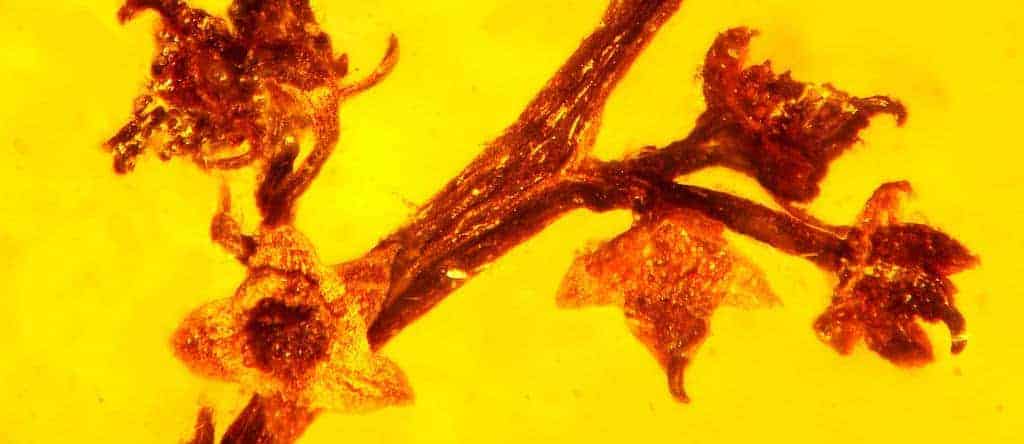
An important discovery was made in Myanmar’s Hukawng Valley, formerly in Burma. George Poinar Jr., an emeritus professor in the Department of Integrative Biology at Oregon State University’s College of Science, discovered Cretaceous flowers in a piece of 100-million-year-old amber. The specimen provides the oldest evidence identified to date of sexual reproduction in a flowering plant.
The plant preserved in amber was named Micropetasos burmensisand consists of a cluster of 18 small flowers, one of which was preserved during the process leading to seed formation. The reproductive process captured in this Cretaceous specimen appears identical to that used by living flowering plants, or angiosperms.
The ancient flowers are exceptionally well preserved and provide insight into the world inhabited by dinosaurs. This small cluster is among the most complete plant fossils discovered in amber and dates to a time when most flowering plants were relatively small.
Microscopic examination revealed a particularly notable feature: pollen tubes growing from two pollen grains and penetrating the flower’s stigma. This marks the beginning of the process leading to fertilisation of the egg cell and, if reproduction is completed, the formation of seeds.
Poinar explained: “I have never before seen a pollen tube penetrating the stigma in a Cretaceous plant fossil.” He added: “This is the advantage of fossils in amber. They are preserved as soon as resin covers them, allowing even structures such as pollen grains and pollen tubes to be detected under a microscope.”
According to Poinar, the pollen appears to have been sticky, suggesting transport by pollinating insects. This finding provides further evidence of Cretaceous biodiversity. The evolution of angiosperms brought major changes to the diversification of life on Earth.
These are not the only flowers from the age of dinosaurs discovered in amber. In another piece of Cretaceous amber from Myanmar, Poinar identified seven additional ancient flower specimens. This was the first study to identify seven complete flowers together. They measure 3.4–5 mm in diameter and were named Tropidogyne pentapterafor their five-petalled form. The flowers appear to have belonged to a tree in the family Cunoniaceae.

“The amber preserved the flowers so well that they look as though they were picked from a garden yesterday,” Poinar said. “Dinosaurs may have struck the branches, causing flowers to fall into resin deposits on the bark of Araucaria, the tree thought to have produced the resin from which the amber formed.”
Micropetasos burmensis and Tropidogyne pentaptera offer a rare view of a world that existed 100 million years ago and demonstrate how many biological features persist from that distant time.
Sources: Oregon State University – study 1, Oregon State University – study 2

”"It appears that the flowers belonged to a coniferous tree and were classified in the Cunoniaceae family."”
A small mistake here – Cunoniaceae are not conifers (Gymnosperms) but angiosperms, therefore it cannot be a coniferous tree.
https://en.wikipedia.org/wiki/Cunoniaceae
Thank you very much for the warning – we have corrected the error!