Approximately 515 million years ago, during the Cambrian, a formidable ocean predator was Anomalocaris. This ancestor of living arthropods could reach 1 metre in length and is the first known apex predator.
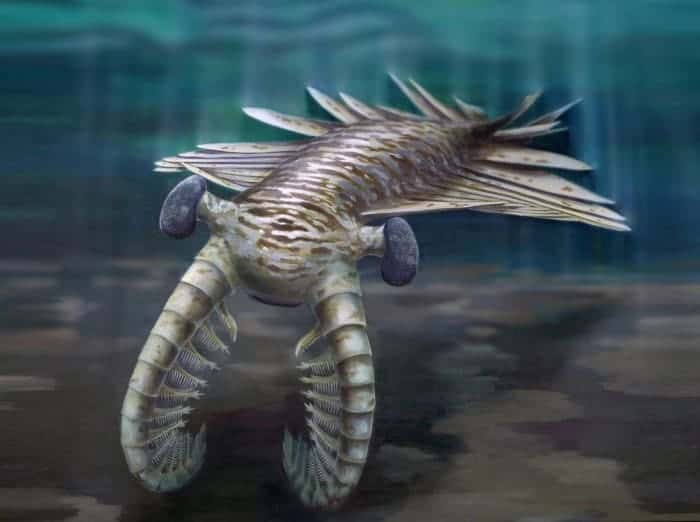
The Cambrian Period saw the emergence of diverse and distinctive forms of life on the ocean floor. Among them was the first apex predator identified by scientists: Anomalocaris.
Anomalocaris, a distant ancestor of modern arthropods, searched the oceans for prey approximately 515 million years ago. Its name means “unusual shrimp”, reflecting an anatomy unlike that of its living relatives. This unusual body structure initially made the extinct animal difficult to identify.
The first fossils of Anomalocaris were discovered in the Ogygopsis Shale by Joseph Frederick Whiteaves, followed by additional specimens found by Charles Doolittle Walcott in the renowned Burgess Shale. Several body parts, including the mouth, a feeding appendage and the tail, were initially found separately. Because the animal’s form was so unusual, palaeontologists interpreted them as three different organisms. Harry B. Whittington and Derek Briggs resolved the puzzle and reconstructed the animal in a paper published in 1985.
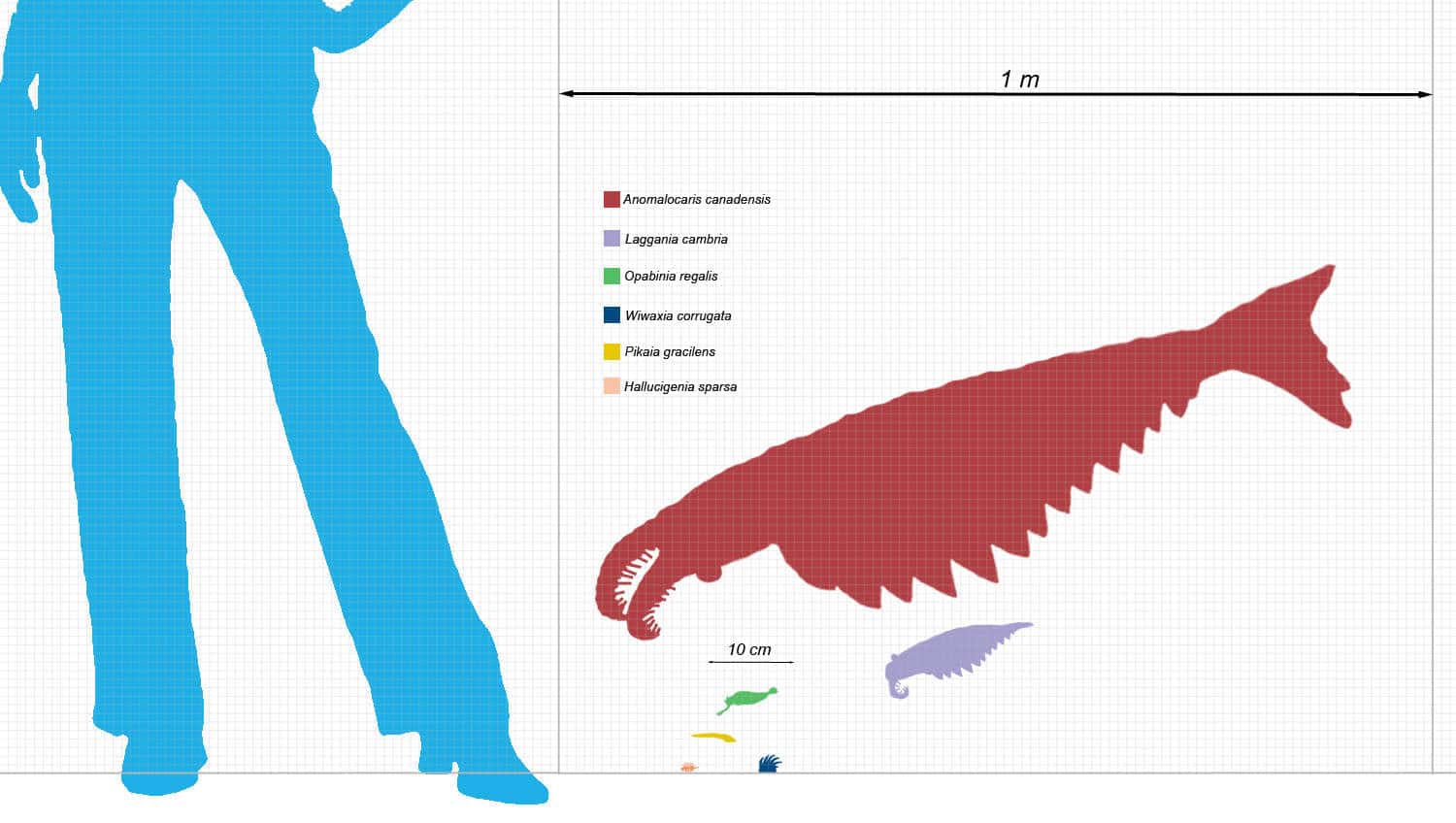
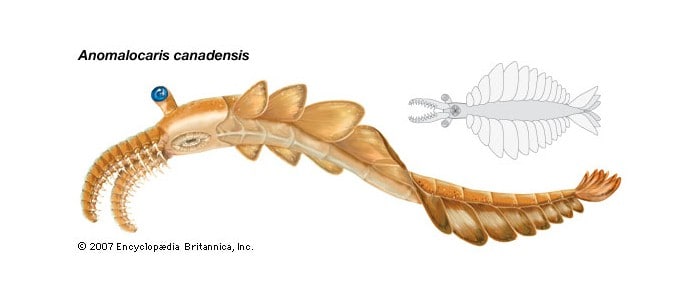
The discovered fossils indicate that Anomalocaris was a predator reaching up to 1 metre in length, an enormous size for its time. It moved through the water by undulating flexible lobes along the sides of its body. The motion passed from one lobe to the next, forming a fin-like system and indicating that Anomalocaris was an accomplished swimmer. This mode of swimming appears to have been highly stable, so the predator may not have required a particularly complex brain to maintain balance while moving.
The body of Anomalocaris was widest between the third and fifth lobes and tapered towards the tail. It had at least 11 lobes in total. The animal had a large head, a pair of large compound eyes with approximately 16,000 lenses, and an unusual disc-shaped mouth.
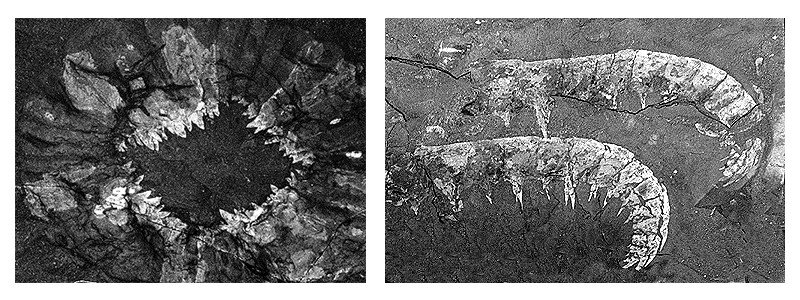
The mouth consisted of 32 overlapping plates, four large and 28 small, resembling the surface of a pineapple, with a central ring of serrated teeth. It could not close completely, and tooth-like structures continued into the oesophagus. Two long, spiny feeding appendages, each reaching up to 18 cm when fully extended, lay in front of the circular mouth. The large, fan-shaped tail was probably used in propulsion.
Recent studies of newly discovered specimens have clarified previously uncertain aspects of this animal and challenged some established interpretations. One concerns the idea that Anomalocaris crushed the hard exoskeletons of trilobites in its mouth. Palaeontologist James “Whitey” Hagadorn of the Denver Museum of Nature and Science told LiveScience: “The general view is that Anomalocaris was a giant predator swimming through the sea and eating trilobites and other vulnerable organisms. My study does not challenge its predatory nature, but it does challenge the idea that it fed on trilobites.”
Hagadorn measured the mouths of 400 Anomalocaris fossils and found evidence that the predator’s mouth consisted of soft tissue. He found no signs of broken teeth or damage of the kind expected in an animal that crushed shells. Many fossils also suggest that the mouth was flexible.
To test this hypothesis, Hagadorn and colleagues created a three-dimensional model of the mouth and investigated its bite force. They used shells of living organisms as analogues for trilobite exoskeletons. The experiment indicated that Anomalocaris could not regularly have fed on trilobites, except very small individuals swallowed whole. Larger, typical trilobites were unlikely prey. “For most trilobites, approximately 95% of them, the mouth of Anomalocaris would have broken before their shells did,” Hagadorn concluded.
Although Anomalocaris may not have been able to break the resistant exoskeletons of trilobites, it had exceptional vision. Earlier fossils suggested compound eyes, but none preserved sufficient detail to confirm them. Palaeontologist John Paterson of the University of New England in Australia and colleagues confirmed this by studying fossils from the Emu Bay Shale of South Australia.
The team found that each eye consisted of thousands of lenses, as in living insects and crustaceans. Robert Gaines, a palaeontologist at Pomona College in Claremont, California, who was not involved in the study, remarked: “The extraordinary detail preserved in this specimen is simply remarkable.”
Simon Conway Morris, a palaeontologist at the University of Cambridge, UK, explained: “It was extremely frustrating to see these eyes in Burgess Shale fossils from the Canadian Rockies without the necessary detail. It is very encouraging finally to have our ideas about these animals confirmed.”
The eyes of these ancient anomalocaridids appear to have contained more lenses than those of most living arthropods. Paterson’s team counted approximately 16,000 lenses in each eye. Paterson noted: “That is a very large number. A common fly has only 3,200 lenses, and most ants have fewer than 1,000. Dragonflies have up to 28,000 in each eye and exceptional vision, but they are unusual among arthropods.”
With exceptional vision and a fast-moving body of enormous size for its time, Anomalocaris remained a formidable Cambrian marine predator even if it could not crush hard trilobite exoskeletons. Even today, such an animal would pose a threat to many marine organisms.

Source: The Smithsonian, LiveScience, Nature
