


Description
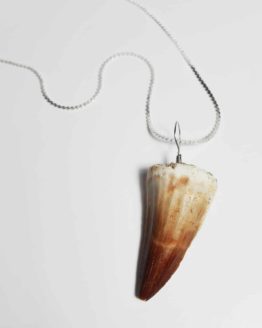
Prehistoric relatives of the Sand Tiger Shark inhabited the seas more than 50 million years ago. They are known mainly from their fossilized teeth, found in places including Belgium and Morocco. These fossils document several extinct species related to sharks living today.
The teeth often have a long, narrow main cusp flanked by small lateral cusplets. Their shape suggests adaptations for grasping and holding prey, including fish. Differences between teeth help palaeontologists distinguish species while also taking their position in the jaws into account.
The Sand Tiger Shark of today, Carcharias taurus, can reach approximately 3.2 metres in length. It lives in coastal waters near reefs, bays and shipwrecks, and feeds mainly on fish, as well as squid, crustaceans, rays and smaller sharks. Its long, pointed teeth give it an imposing appearance, although it is not generally considered aggressive towards humans.
The living species also has an unusual adaptation: it swallows air at the surface and stores it in its stomach to control its buoyancy. This allows it to remain almost motionless in the water above the seabed.















Reviews
There are no reviews yet.