Out of Stock

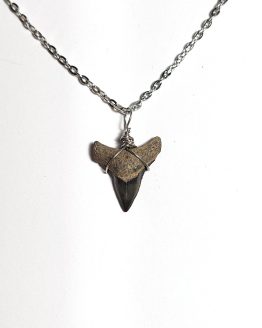
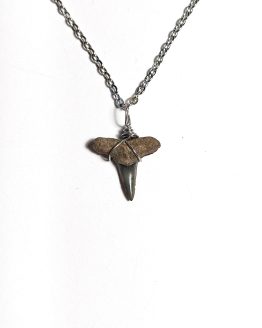
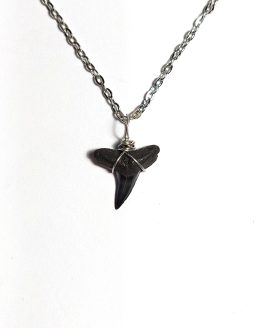
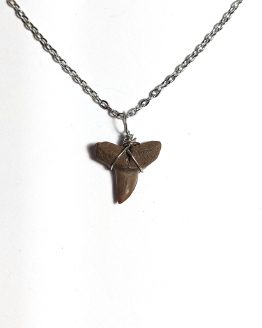
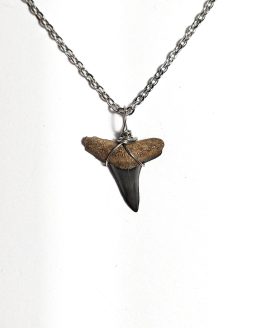
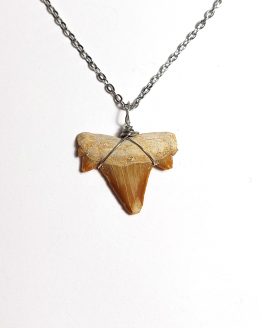
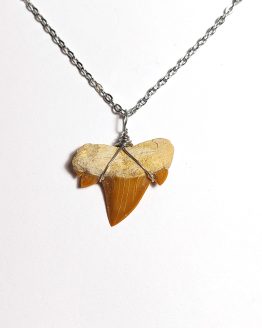
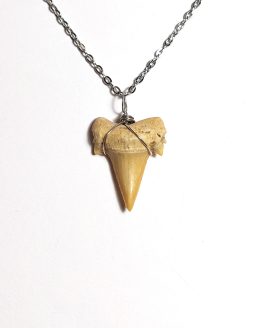
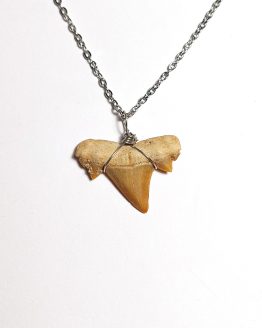
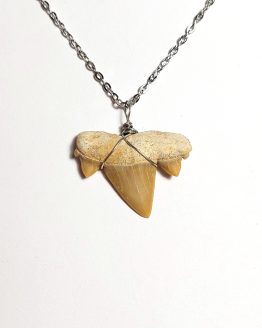
Handmade necklace with authentic fossilized Sand Tiger Shark tooth · 1.6 cm pendant length

50 million years old · Eocene · Morocco

RON 29,99

Handmade necklace with an authentic fossilized Sand Tiger Shark tooth pendant on a silver-colored metal chain. The tooth is approximately 50 million years old and comes from Morocco. A unique opportunity to wear a special piece of jewelry with an impressive past!

Sharks have a very large number of teeth arranged in several rows and replace them many times during their lives (sometimes even weekly). This, combined with the durability of tooth enamel and the long span of time during which Sharks have existed, makes fossilized Shark teeth common in many parts of the world.

Due to the age of the specimen and the fragmentary nature of the fossil deposits in Morocco, as well as local extraction methods, the tooth may have imperfections and repaired areas (glued sections) which are perfectly normal and often unavoidable, but it is, overall, in good condition, with the enamel layer almost intact. We invite you to carefully study the product photos to identify the natural imperfections and possible repairs of the specimen.

Click here for more general information about fossils

Pendant: authentic fossilized Sand Tiger Shark tooth 

Age: about 50 million years old, Eocene epoch

Country of origin: Morocco

Pendant dimensions: approximately 1.6 cm in length along its longest side (please see the photo showing the specimen next to a ruler or held in a hand to get an idea of its size)

Chain: silver-colored metal

Chain dimensions: approximately 44 cm length

The product consists of a single handmade necklace with an authentic fossilized Sand Tiger Shark tooth pendant on a silver-colored metal chain, the one in the pictures above, and comes with a brochure containing specific geological and paleontological information.

Out of stock

Description

The Sand Tiger Shark of today, Carcharias taurus, is one of the most spectacular-looking sharks. Its long, narrow, dagger-like teeth remain visible even when its mouth is closed. The small spikes at their base help it catch and hold slippery food.

This shark roams coastal waters, near reefs, bays and wrecks, where it finds a wide variety of food. It mainly eats fish, but also squid, crustaceans, rays and sometimes smaller sharks. Large specimens can reach about 3.2 meters in length. Despite its impressive appearance, it is not usually considered aggressive towards humans.

It also has an unusual adaptation: it can rise to the surface to swallow air, which it stores in its stomach. This helps it control its buoyancy and remain almost motionless in the water, like a predator suspended above the seabed.

The Sand Tiger Shark also has extinct relatives, known from their fossilized teeth. These retain the characteristic shape, with a long, narrow tip and small lateral spikes, suitable for catching fish and other marine animals. The modern shark provides us with a good reference for what these animals looked like and how they used their teeth.

Sand Tiger Shark
The Modern Sand Tiger Shark – author Jeff Kubina, Wikipedia – the image has a strictly illustrative role and is not part of the product

Reviews

There are no reviews yet.

Be the first to review “Colier handmade cu dinte fosilizat autentic de Rechin Tigru de Nisip, 1,6 cm lungime pandantiv, 50 mil ani, Eocen, Maroc”

Your email address will not be published. Required fields are marked *


Fossil jewelry

0
0
Your Cart
Your basket is empty