Out of Stock

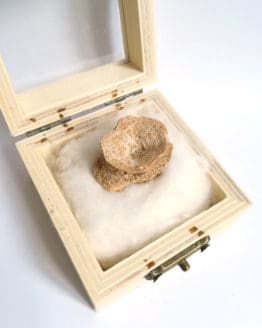
Authentic fossilized whale tympanic bulla, 10.0 cm long, 15 million years old, Miocene, Belgium

RON 119,99

Authentic specimen of fossilized whale tympanic bulla (most likely a sperm whale, Physeter sp.) from Belgium, approximately 15 million years old. It comes with a Certificate of authenticity signed by a professional geologist who examined the specimen. The tympanic bulla or auditory bulla is an anatomical formation of the auditory system present in many mammals, which has the shape of a half-sphere or egg. It is found in cetaceans (whales and dolphins) but also in many rodents, carnivores and ungulates and has the role of amplifying certain frequencies. An excellent gift for a paleontology and marine life enthusiast!

Due to its age, the specimen may have imperfections and repaired areas (glued sections) that are perfectly normal and inevitable for such an old fossil, but it is, overall, in good condition. We invite you to carefully study the product photos to identify the natural imperfections and any possible repairs to the specimen.

Click here for more general information about fossils

Specimen: authentic fossilized tympanic bulla of a whale (most likely a sperm whale, Physeter sp.)

Age: approximately 15 million years old, Miocene epoch

Dimensions: approximately 10.0 cm long (Please take a look at the photo where the specimen is placed next to the ruler/in the hand to get an idea of its size)

Country of origin: Antwerp, Belgium

The product consists of a single authentic fossilized whale tympanic bubble, the one in the pictures above, and comes with a brochure containing specific geological and paleontological information, as well as a Certificate of authenticity signed by a professional geologist who has examined the specimen

Out of stock

Description

Whales are a group of fully aquatic marine mammals that first appeared about 50 million years ago, during the Eocene epoch, and are still alive today. There are two major groups of whales, the baleen whales and the toothed whales, and their last common ancestor lived about 34 million years ago. The whales' closest land relatives are the hippopotamuses, from which they diverged about 54 million years ago.

Whales are fully aquatic mammals: they can feed, mate, give birth, nurse, and raise their young at sea. Whales range in size from the dwarf sperm whale, at 2.6 meters and 135 kilograms, to the blue whale at 29.9 meters and 190 tonnes, which is the largest known animal ever to have lived. At the same time, the sperm whale is the largest toothed predator on Earth.

Baleen whales have no teeth; they feed on krill and plankton (very small marine animals), which they swallow in huge quantities and then filter out by expelling the swallowed water through their baleen plates. Because their heads are enormous – accounting for up to 40% of their body mass – and they feature throat grooves that allow their mouth to expand, they are capable of engulfing vast amounts of water at once. Baleen whales also possess a highly developed sense of smell.

Toothed whales, in contrast, have conical teeth adapted for catching fish or squid. Their acute hearing, both above and below the water’s surface, can allow some individuals to survive even when blind. Sperm whales are particularly well adapted to deep diving in pursuit of squid and other prey.

Eubalaena australis whale
Modern Southern Right Whale Eubalaena australis – author Michaël Catanzariti, Wikipedia – image is strictly for illustrative purposes and is not part of the product

Reviews

There are no reviews yet.

Be the first to review “Bulă timpanică fosilizată autentică de balenă, 10,0 cm lungime, 15 mil ani, Miocen, Belgia”

Your email address will not be published. Required fields are marked *


Fossil jewelry

0
0
Your Cart
Your basket is empty