Approximately 70 million years ago, during the Cretaceous, a giant frog called Beelzebufo ampinga could reach 41 cm in length and had a powerful bite that may have enabled it to prey on small dinosaurs.
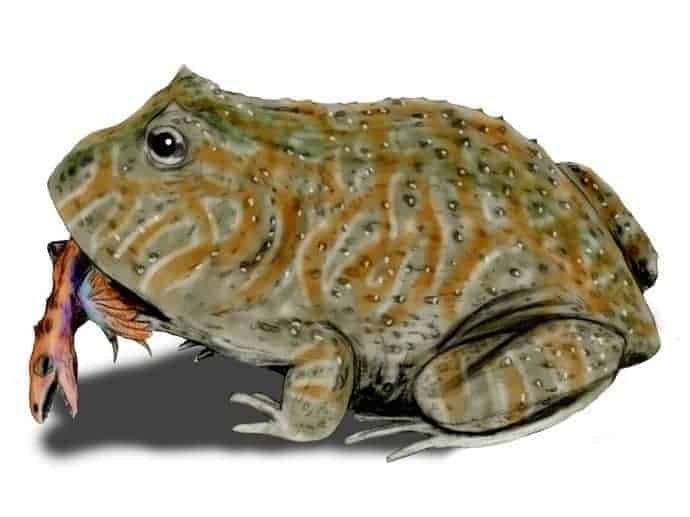
Seventy million years ago, dinosaurs were not the only giant animals on Earth. Even frogs could pose a substantial predatory threat.
Beelzebufo ampinga was a giant frog approximately the size of a beach ball, with a bite thought to have been powerful enough to capture small dinosaurs. It is the largest frog known from discoveries to date. It could reach 41 cm in length, weighed approximately 4.5 kg and lived in Madagascar during the Late Cretaceous. Its name combines Beelzebub – Greek for “devil” – and bufo – Latin for “toad”.
Although Beelzebufo ampinga became extinct long ago, it resembled modern horned frogs in the genus Ceratophrys. These frogs are ambush predators: they remain motionless until prey approaches, then seize it forcefully. Their rounded shape and exceptionally large mouths have earned Ceratophrys the nickname “Pacman frogs”, after the well-known 1980s video game.
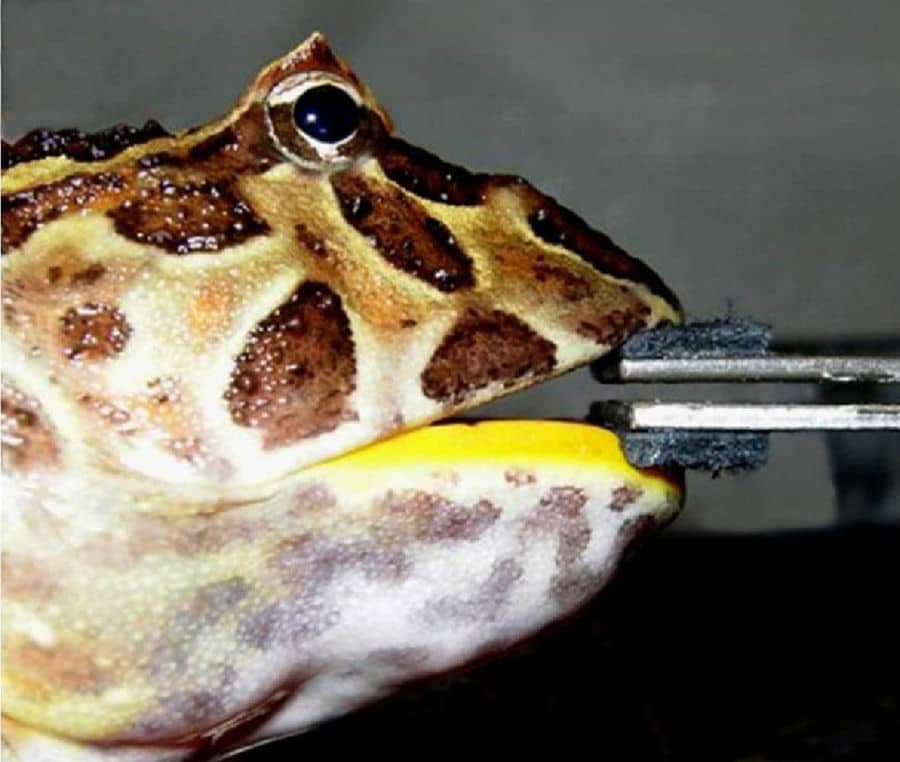
Because of this resemblance, Ceratophrys frogs were used in a recent study to estimate the bite force of the extinct Beelzebufo ampinga. The experiment used a force transducer consisting of two leather-covered plates. When a frog bit the plates, the device measured its bite force precisely.
The researchers found that a Ceratophrys frog with a head approximately 4.5 cm wide exerted a bite force of 30 newtons, equivalent to about 3 kilogram-force. This allows it to retain prey in its powerful jaws after capturing and drawing it into the mouth with its sticky tongue.
Dr Marc Jones, of the University of Adelaide and the South Australian Museum, explained: “Unlike most frogs, which have weak jaws and generally feed on small prey, Ceratophrys ambush animals as large as themselves, including snakes, rodents and other frogs. Their powerful jaws are essential for capturing and restraining prey.”
Scaling the measurements to a mouth approximately 10 cm wide produced an estimated force of 500 newtons, equivalent to about 50 kilogram-force. This is comparable to the bite force of turtles, some crocodilian species and predatory mammals with mouths of similar size.
Using this method, the team estimated the bite force corresponding to the mouth size of Beelzebufo ampinga. Its mouth was approximately 15.4 cm wide, suggesting a bite force of up to 2,200 newtons, equivalent to about 224 kilogram-force. Such a force would be more than sufficient to fracture human fingers.
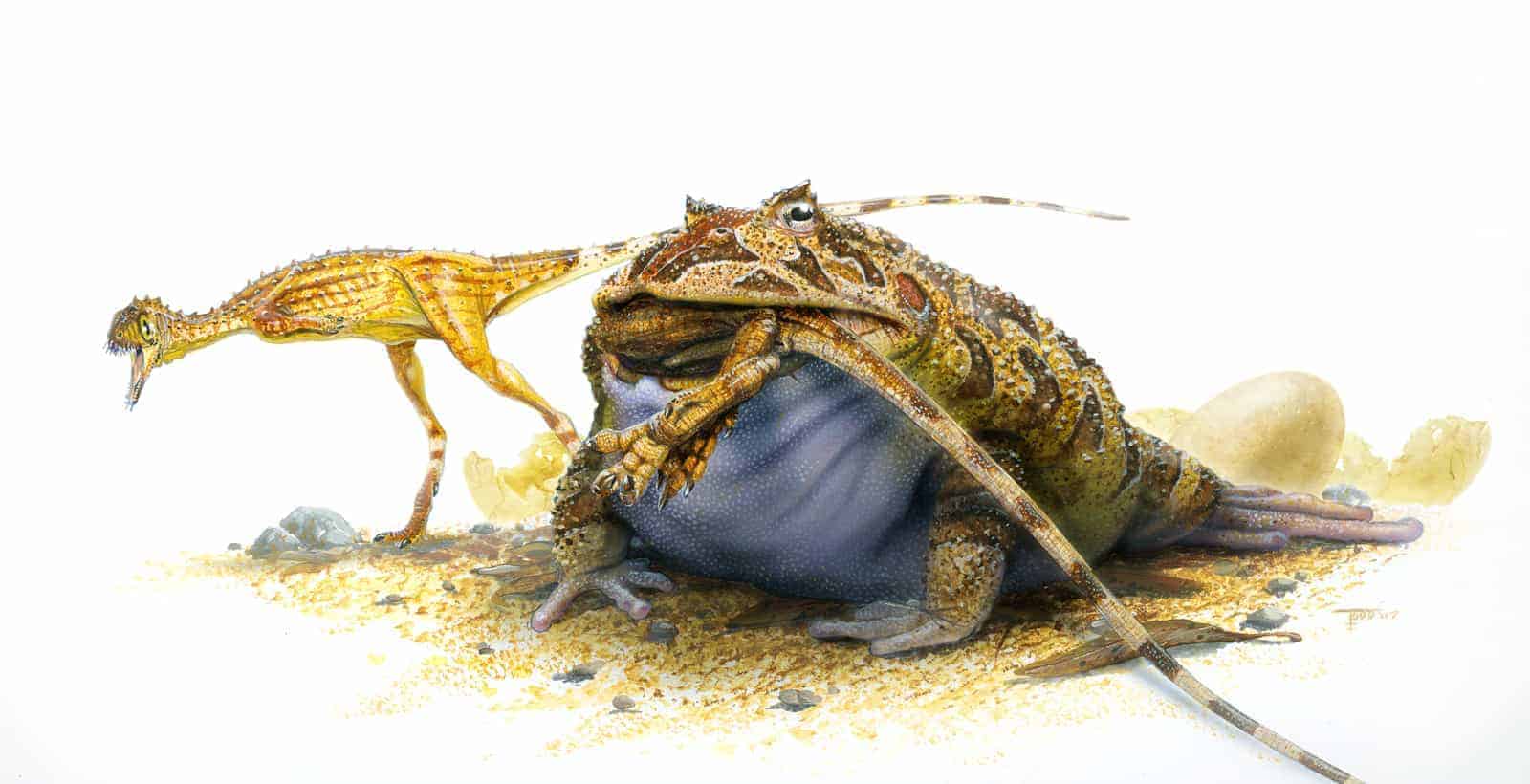
“With a bite force of this magnitude, Beelzebufo ampinga would have been capable of incapacitating small dinosaurs or young dinosaurs that shared its environment,” Dr Jones concluded.
Sources: Nature, ScienceAlert, National Geographic,
